The Meiji Shrine in Central Tokyo is one of the largest Shinto shrines in Japan. It was dedicated to the deified spirits of Emperor Meiji and his wife for their role in the Meiji Restoration.
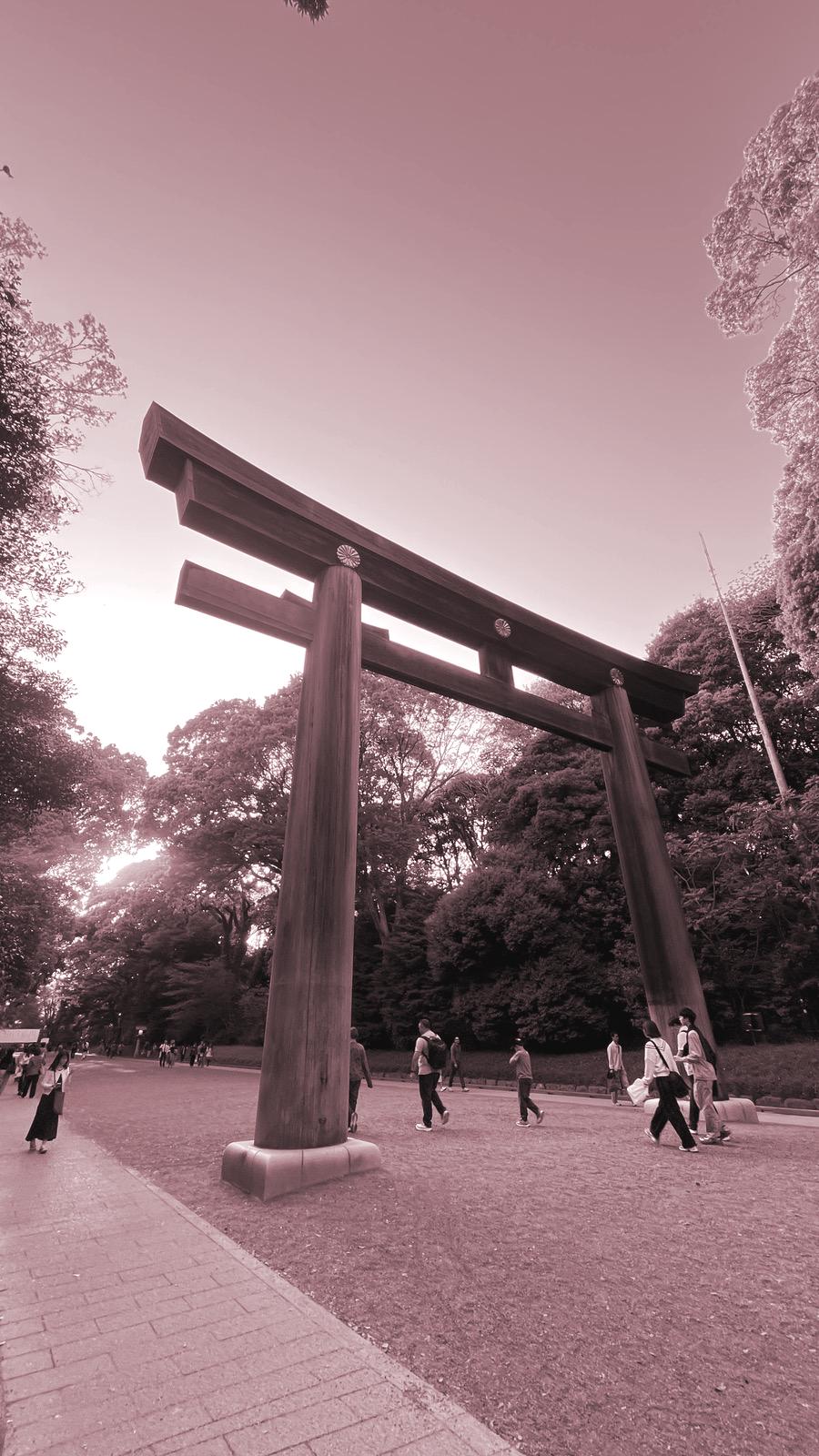
Despite being built in 1920, the shrine and the surrounding park don’t look their age — stepping through the torii gates on the southeastern side, you’re immediately plunged into what looks like an ancient hinoki (Japanese cypress) forest that has been there for centuries.
You could almost completely fall for the performance put on by this shrine, believing you’re actually looking at ancient Japanese tradition, when in fact, the main timbers that make up the Shrine, as well as the largest torii gate of the Shrine, are actually from Alishan in Taiwan.
The Meiji Restoration calls for a return to Japanese traditionalism, a revival of Shintoism, and return of the Emperor as source of legitimacy. What I found in my recent trip to Tokyo is that much of the Meiji aesthetic is materially underwritten by empire, and that the “traditional” and “imperial” aren’t in tension, but the core duality of the entire project.
During this trip, the question I wanted to answer was:
Can I find remaining pieces around Tokyo that tell the story of how a previously feudal and decentralised system of governance changed to become a hemisphere-spanning Empire?
Mobomoga
Our trip begins in Ginza, a luxury shopping district, and in my opinion home to the best cocktail bars in Tokyo. After barely managing 3 hours of sleep the night before, I make my way through Ginza high street to start the first part of my day’s itinerary—the Marunouchi-Hibiya corridor.
The glitz and glamour of the skyscraper-tall luxury stores wasn’t always the aesthetic of Ginza. The neighbourhood was initially made up of Edo period wood and paper houses that were so prone to fires that a common saying was “Fires and fights are the flowers of Edo”. In 1872, however, a large fire culled most of the buildings in the area, making way for the current iteration of Ginza, clad with trendy shopfronts and cafes.
This unplanned re-branding of Ginza unintentionally created the third space for a new class of Japanese haikara (high-collar) workers. Created by Meiji industrialisation, and later referred to as Mobomoga, “Modern Boys and Modern Gals”, these young, upwardly-mobile professionals were rushing in from rural Japan to take up biru (office) jobs in Marunouchi, just a stone’s throw away from Ginza. This hip Ginza aesthetic was the perfect backdrop for this class of Yuppies to burabura (“wander aimlessly”). So specific was this activity to Ginza that gimbura or “wasting time in Ginza” was coined as a term.
This rapid urbanisation and hollowing out of the Japanese countryside quickly stirred up class and social divisions. The young, fashion-conscious, and sexually emancipated Mobomoga were seen as superficial, materialistic and enamoured with Western values. In contrast, the bankara (“barbarous-collar”) class, primarily a student subculture aesthetic, deliberately rough and anti-bourgeois, was seen as the intra-urban resistance to novelty, and protection against corrupting Western values. While only the mobo had full suffrage, it was the moga that caught the ire of social conservatives, who saw their sexual and financial liberation as a direct contradiction of the Meiji State’s ideal of a “good wife, wise mother” engaged in her family obligations.
In a sort of weird foreshadowing, my morning 800m walk between Ginza and Marunouchi already showed me that the Meiji settlement contained an irresolvable contradiction from the beginning. The need for strong industry as power projection creates a new class of financially independent high collar workers, driven from the countryside into Marunouchi biru. The social anxiety generated by this new class of emancipated Mobomoga during the unheralded Taisho era is exactly what the later Showa discourse of “restoring Japanese spirit” claims to resolve. Both Ginza’s hedonism and Marunouchi’s performance of disciplined, Western-facing institutional power are born out of the same state-building project that the Meiji government was aiming to achieve, and they sit in constant tension and contradiction to each other. Paradoxically, Meiji Japan was simultaneously emulating and rejecting Western values.
The Meiji Imperial Rescript on Education, which established a moral and civic foundation for modern Japan, was issued in 1890, 30 years before the Mobomoga. The Showa militarist “return to Japanese spirit” was invoking a mythologised Meiji that was already ideologically anxious about the social consequences of their own programme before those consequences had fully materialised.
Putting on a performance
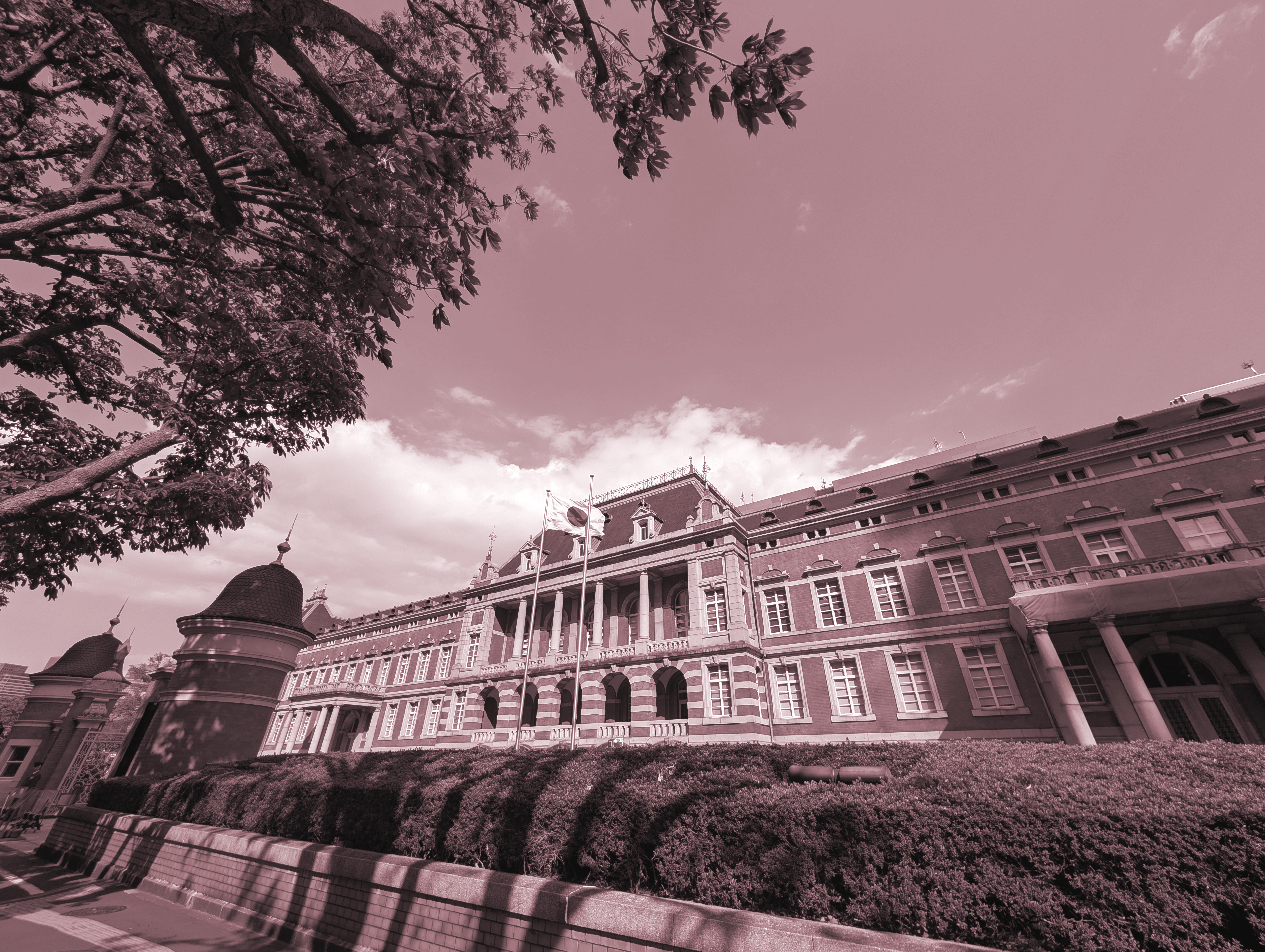
After dodging the tourists and anti-loitering Mosquito alarms in Ginza, I find myself at the top of the Marunouchi-Hibiya corridor. From the Tokyo Station to the old Ministry of Justice building, the neo-Baroque style is the dominant piece in an otherwise unremarkable sea of metal and glass office monoliths. The reason I’m here is because a central part of Meiji legitimacy rested on the performance of institutional power given to the West, with the specific aim of renegotiating the unequal treaties that Tokugawa Japan was forced to sign.
I can’t describe how odd I felt the first time I stood in front of the Tokyo Main Station. A red brick building, with arches, balconies and rows of windows that you’d expect from a building on a Western boulevard, is sitting proudly, and almost uncannily fitting in with the Tokyo environment.
For the first couple of trips to Tokyo, I chalked the architectural choices up to infatuation with the West. This deeper look into it though, made me change my view from this being a product of infatuation, to simply pragmatism, necessity, and the Meiji state’s demonstrated capacity to ingest foreign forms, digest them and deploy them for domestic legitimacy purposes. The institutions were built to serve the Empire, so it’s no surprise that the seat of institutional power is built right around the Imperial Palace. Not only that, Meiji Japan specifically contracted German architects to design symbols of institutional power that not only showed competence, but were legible to Western nations.
Picking German architects showed that a freshly unified Germany was seen as a model nation to emulate due to its modernisation and militarisation. Achieving these milestones without being fully Anglicised was also something highly sought after by the Meiji government.
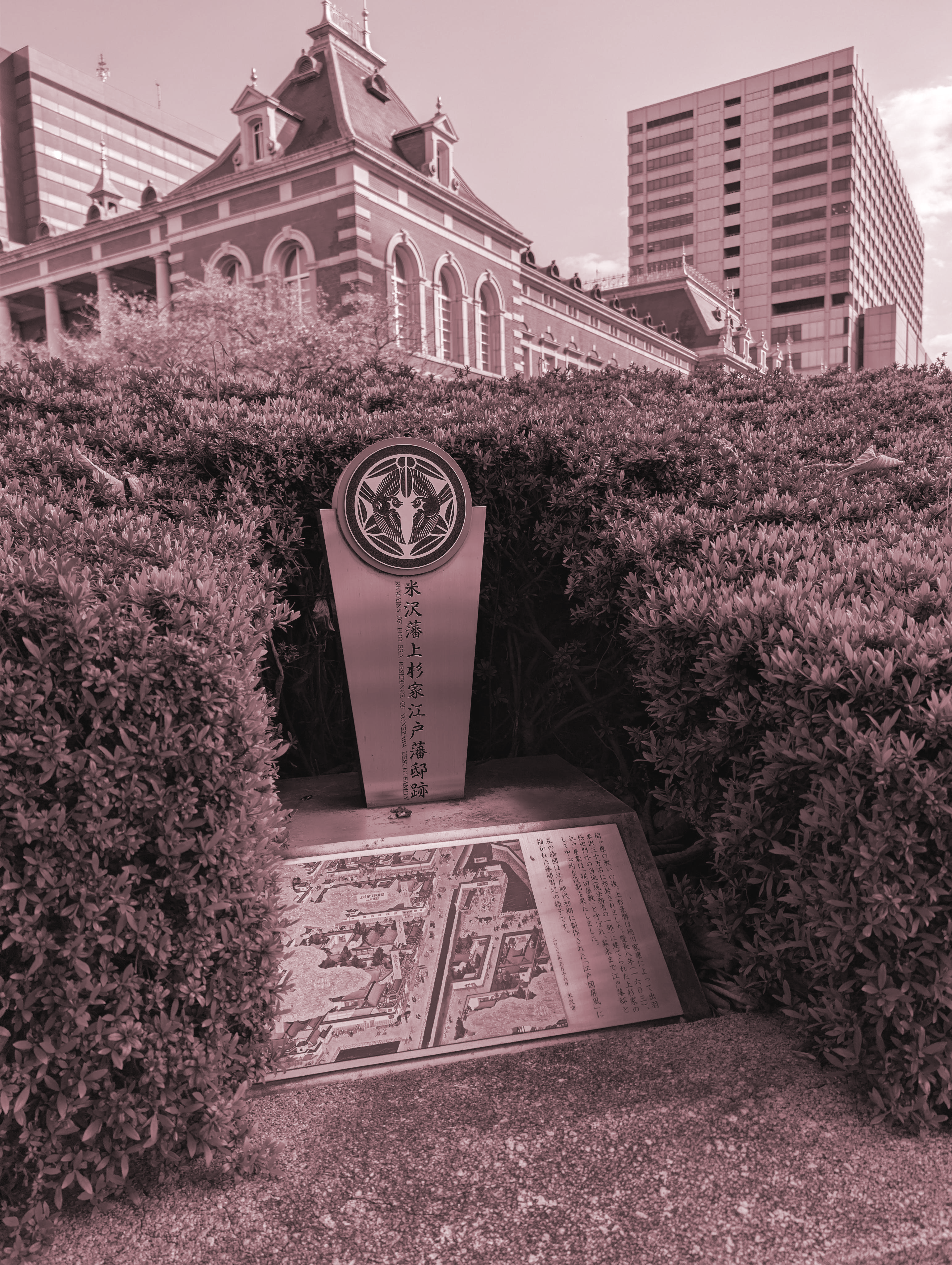
The cherry on top was finding this plaque hidden within a bush fence. The plaque notes that the Ministry of Justice building was built atop old Uesugi clan lands, another instance of the Imperial state literally building over the old feudal order.
The dialectics of the Meiji era
The progression from the feudal arrangement of society, to rapid industrialisation and embourgeoisement of the mobomoga as well as the centralisation of state power is a bit dizzying. Hegel’s dialectic gives us an analytical frame through which we can look at this tension between Japanese modernisation (and Westernisation) and the Meiji call for a return to Japanese spirit in cycles of thesis-antithesis-synthesis.
In the first cycle, the thesis: Tokugawa shogunate keeps stability through deliberate closure. The feudal system, with a strict class system and distributed political power maintains legitimacy through its monopoly on foreign contact and ability to guarantee domestic order. The antithesis, Commodore Matthew Perry’s arrival exposes that monopoly as fictional—the shogunate can’t expel the foreigners, cannot renegotiate the treaties and cannot fulfil its foundational legitimacy claim. The cycle’s synthesis is that the Emperor is restored as the locus of sovereignty. The aesthetics of return are working overtime here, since the Emperor hasn’t actually exercised real power in ages.
Our next cycle continues from where the first one left off: what is the Emperor’s sovereignty actually for, and who controls it in practice. The thesis is the Meiji state needing Western institutional reforms via a conscript army, a centralised bureaucracy and constitutional government. The antithesis is that Western forms at scale produce Western social outcomes that the social conservatives bemoaned (wage labour, financial independence, gender strife, individualism). The unstable synthesis is “Japanese spirit, Western technique”.
In the final cycle, the thesis is Japan as a modernising sovereign state within the Western international order. The antithesis, however, is that the Western order is an imperial one—Japan is left with a choice: be the coloniser, or be colonised.
The final synthesis completes the logical chain—Japan as Empire. Meiji treaty renegotiation requires demonstrable state capacity, state capacity needs an industrial base, the industrial base needs resources, and resources need territorial control. The Alishan cypress within the Meiji Shrine is the material residue left from this logical chain.
Japanese spirit, Western technique
My final day of the trip was spent at the Tokyo National Museum in Ueno. Coincidentally, the Battle of Ueno was the last major stand for the Tokugawa shogunate in Edo (modern day Tokyo). Though I only realised this when I started researching for this blog, it did really feel cathartic to have the last piece of my trip lead me here.
The walk up through Ueno Park feels like approaching the Tokyo National Museum through a palace garden that has been opened up to the public. Families, tourists and buskers are scattered around the park enjoying different activities. Arriving at the ticketing gate, you’re face to face with the Honkan (main building), a deliberately hybrid Japanese-Western style, designed by Jin Watanabe. The original conception of the TNM was heavily based on the South Kensington (now Victoria & Albert) Museum, though it was redesigned following the Great Kanto Earthquake of 1923. Personally, I was more intrigued by the Toyokan building, with its massive exposed concrete body with minimal fenestration, and the delicate roof that maintains the Japanese aesthetic, but I digress.
Entering the Honkan, I took the entryway directly into the permanent exhibition sections, starting with the Edo period exhibit on the second floor. During the Edo period, the cultural production mechanism seemed consciously downstream from Zen Buddhism as well as Tang and Song dynasty aesthetics. The minimal brush work, negative space and vertical scroll format made the world in the painting seem suggested, not depicted, and the author seem dissolved into the technique. I did feel an odd sense of déjà vu, like I’d just stepped into Taipei’s Literature Museum rather than the Tokyo National Museum.
The bigger surprise came from the Meiji era art on display downstairs. In contrast to the paintings upstairs, these paintings are the assertions of a subject who stands outside the world and depicts it. “I see this, I command this view, and I can render it with scientific accuracy” was what these paintings were saying. The thick gold frames, perspective, chiaroscuro and vividly saturated colours were distinctly European.
This is a callback to our earlier finding of Japanese ability for cultural absorption, digestion and reinterpretation. Whether Edo era paintings reinterpreting Song and Tang dynasty technique, the neo-Baroque architecture modelling Bismarckian Germany, or the Imperial art reinterpreting Western-style painting, this was demonstrating legibility to a Western audience, demonstrating that Japan could produce the forms of civilisation that Western powers recognised as such.
Besides art, I found the Edo period bureaucracy and attention to detail fascinating. The Tokugawa bureaucratic state was remarkably sophisticated, and I got the chance to take a look at some high-detail flyover maps of Edo (modern Tokyo) on display at the TNM. When the Meiji government came to governing, they didn’t inherit chaos, they inherited a century of administrative data and institutional practice. The conscript army, land tax reform and prefecture system moved fast because the informational substrate already existed.
Yokosuka, the day trip that never was
My last couple of days in Japan were supposed to be spent in Yokosuka, admiring the ship Mikasa. The flagship of the Battle of Tsushima, now preserved in Yokosuka, the Mikasa was part of a genuinely decisive naval engagement by the Japanese navy in the Russo-Japanese war. More than anything, the Mikasa was the emblem that an Asian nation could destroy a great European power’s fleet in open battle.
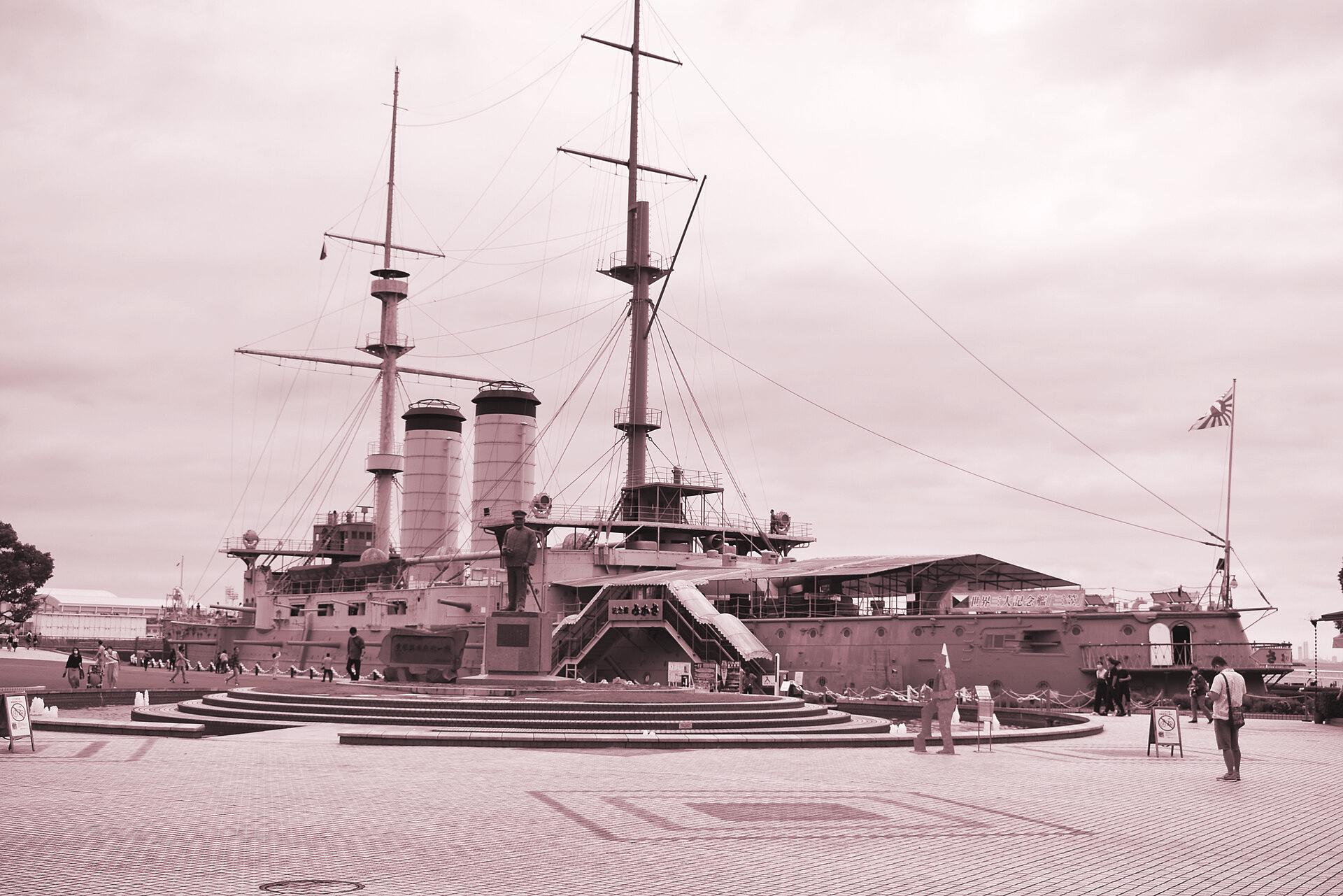
Would I go to Yokosuka for a damn ship? Probably not. My reason for planning to visit wasn’t to bask at an instrument of victory, but to look at the ship the same way Meiji military leaders did—a capable ship, financed in part through American war bonds arranged by Jacob Schiff of Kuhn, Loeb & Co., motivated as much by opposition to Tsarist pogroms as by financial opportunity. Meiji Japan knew that it was already deeply embedded into Western financial dependency, and I think this was even more of an impetus for Japan to move towards resource accumulation and becoming a creditor themselves.
Meiji Japan needed treaty renegotiation. This created a long chain of events that culminated with a forest in Taiwan being the source material from which Japan built its most sacred symbol of timeless tradition. The performance is perfect. That’s the point. The shrine looks ancient because it was designed to. The torii gate looks Japanese because nobody asks where the wood came from. The Meiji Restoration looks like a return because the thing being returned to was constructed at the same moment as the return itself. Empire doesn’t announce itself as empire. It announces itself as tradition, as necessity, as the natural order of things. Tokyo still tells this story, if you know which buildings to stand in front of.