There’s a genre of essay that has been circulating in Taiwan-watcher spaces for a while now, and I think it carries enough analysis, and a critical enough reading of the situation, that it deserves to be engaged with rather than shouted at. The argument runs roughly like this: the status quo is a barrier lake that must eventually breach, China’s relative power only grows, America has turned from protector to racketeer while extracting TSMC’s leading edge to Arizona, and so the responsible, unsentimental move is to negotiate terms while Taiwan still holds leverage.
I think the diagnosis is correct. All of it. The status quo is deteriorating. Washington’s behaviour has turned extractiveHoward Lutnick demanding half of advanced chip production onshore[1] . Holding back a $13B air-defence package that Congress had already informally cleared so that a planned summit in Beijing would not be disrupted [2] is not what allies do to allies. The 1990s, when Taiwan’s economy was around 40% the size of China’s rather than today’s 5%, was a moment of vastly greater relative weight.
Where the argument fails is on the prescription, and it fails on its own terms rather than on moral ones. What follows is an audit of that accounting, run on the same cold arithmetic the case claims as its home turf.
Leverage is worth what enforcement is worth
The negotiate-now argument carries the assumption that terms agreed under favourable leverage stay agreed. The test case for this assumption has already run though, to a pretty humbling failure.
The 1984 Sino-British Joint Declaration was a treaty registered at the United Nations, guaranteeing Hong Kong’s autonomy for fifty years, signed by a nuclear-armed permanent member of the Security Council. In 2017, Beijing’s Foreign Ministry described it as “a historical document that no longer has any practical significance” [3]. The remaining thirty years of guaranteed autonomy were liquidated in roughly eighteen months after 2019. London held more leverage in 1984 than Taipei will ever hold, and what it bought was paper.
So the choice was never really “good terms now versus bad terms later”. Negotiated terms converge to Beijing’s preference at Beijing’s chosen speed regardless of the leverage that produced them, because there is no court, no guarantor, and no enforcement mechanism that survives the handover. A deal negotiated from 40% relative GDP in 1996 would have decayed on the same schedule as one negotiated today.
Many pro-American diehards will point out that Beijing is a special case, and that commitments made by democracies with independent courts and a free press are a different species. I think that’s laughable. One of the Six Assurances that the Reagan administration sent to Taipei in 1982 is generally read as a commitment to not consult Beijing before an arms sale to Taiwan. When talking of Xi, and the sales, Trump said, on the record, “I’m takling to him about it”, effectively breaching exactly that assurance [2]. My point isn’t that “they’re all the same”, but rather that unenforceable commitments decay regardless of whoever signs them, and the decay rate is set by how inconvenient they become, not the character of the signatory. A unification agreement would be the most inconvenient document either Taipei or Beijing had ever signed.
Which leads me to my next point…
The Three Daughters, and Taiwan as a “laboratory of free thinking”
In the defeatists’ mind the optimistic scenario runs like this: Macau kept its casinos, Hong Kong kept its capital markets, and so Taiwan could keep its democracy, a “laboratory of free thinking” inside a China large enough to contain multitudes.
Let’s look at where Beijing has actually preserved a territory’s distinctiveness, and where it has liquidated it.
Macau’s gambling monopoly survived because it threatens nothing and served a function, as a contained release valve, taxed and surveilled. Even there, it’s worth watching what happened once the centre’s needs changed. Xi’s anti-corruption campaign cratered Macau’s gaming revenue by more than a third in a single year across 2015, and Beijing subsequently dismantled the entire junket ecosystem, with Suncity liquidated and Alvin Chau sentenced to 18 years in 2023 [4,5]. The obedient daughter’s prosperity turned out to be a policy knob, which gets turned in tune with domestic policy, not assurances towards the territory.
Hong Kong’s capital markets survived because they serve a structural need. With the RMB non-convertible, Hong Kong is how China taps foreign capital while keeping the main vault locked. What did not survive is the instructive part: elections, courts and press, i.e. everything whose preservation was inconvenient.
Applying that same mechanism to Taiwanese democracy is markedly worse, because it’s neither profitable, nor convenient. A “laboratory of free thinking” is the single most expensive thing in the entire Sinophone world: a standing, Mandarin-language, same-civilisation falsification to the claim that Chinese modernity is built on Leninist rule. Post-annexation, such a laboratory would be the digital congregation spot for every mainland dissident with a VPN connection.
Everything Taiwan would be negotiating to keep does not survive the model proposed under the “Three Daughters” model, because survival of Taiwanese democracy and plurality is antithetical to the Mandate of Heaven granted to the Communist Party of China. What remains, is whatever Beijing finds useful, which, as we’ll see shortly, isn’t very much, nor very prosperous.
Nobody inherits the golden goose
The arguments put forth here mostly attack the fear that Beijing would be looting TSMC, but my argument is that’s not even the point to be concerned about. TSMC’s value does not live in Hsinchu. It lives in a dependency network that Taiwan itself doesn’t control: EUV lithography from ASML, already export-banned to the PRC with Hong Kong and Macau included, American EDA software licences, US IP, Japanese and American tooling I recently learned that TOTO, the toilet maker, is also producing ceramics for advanced semiconductor production , and a customer base that is legally barred from sourcing leading-edge silicon from a PRC entity [6].
The same day PRC sovereignty applies, entity-list treatment applies with it, simply as existing law. The TSMC fabs instantly become the world’s most expensive stranded assets by default, with the engineers leaving through the ramps already built towards Arizona, Kumamoto and Dresden. That same instant, Taiwan goes from a top nation in terms of GDP per capita, to a backwater province within the PRC, taking the generous Taiwanese welfare state of subsidised …everything… down with it. Taiwan is often cited as having one of the best healthcare systems in the world.
The motivation for annexation is thus not economic, and China’s multi-decade irredentist project isn’t deterred by a spreadsheet, but by cost: human and political.
Deterrence: the muskets are the cheap part
This is where I think the defeatist, pro-unification case makes the most insidious move. Taiwanese resistance is treated as absurd (“every citizen a drone operator, for Freedom!”), while dismissing the defence budget as a rounding error against China’s. Will is treated as absurd, capability as futile.
Firstly, capability is the cheap input. Deterrence-by-denial, where you make crossing fail rather than matching the PLAN ship-for-ship, is cheap, and carries the defender’s advantage. A country with functionally no navy sank the Black Sea Fleet’s flagship and drove the rest of it out of Sevastopol using truck-launched missiles and drone boats [7]. The Houthis were able to choke the Red Sea with cheap missiles and drones, and Iran, a country with virtually no air force, is able to dictate the situation in the Gulf againt the world’s largest and most capable military.
An opposed amphibious landing across 100 nautical miles and more is the hardest operation in warfare, and wargaming consistently shows invasion attempts failing at catastrophic cost when the defender holds enough mines, coastal missiles and munitions [8]. Doubling a rounding error is only pointless if you’re playing the game where the totals are what matter. Taiwan doesn’t need to outspend China, it needs to make one specific operation unaffordable.
Will is the expensive input though. Deterrence works in proportion to the cost of the signals the sender is willing to bear, and Taiwan’s costly signals are currently mixed. On one hand, there’s a record 2026 defence budget of 3.32% of GDP [9]. On the other, the NT$1.25T asymmetric-capability special budget was cut to just NT$780B by the opposition legislaturethe same opposition legislature that has previously frozen submarine funding and trimmed ammunition and fuel budgets [10] . On one hand, conscription is extended to one year, but on the other, the force runs at roughly 80% of authorised strength [11]. This is even before we talk about the gargantuan $29.72B in US arms is already paid for and undelivered [12], the depleted stock of US interceptors and air-to-surface missiles [13], and the same February 2026 freeze that covered exactly the Patriot interceptors, NASAMS and anti-drone equipment that denial is strategically built from [2].
Annoyingly, during the US-PRC summit, Beijing spent that summit tying Taiwan explicitly to the commercial relationship. Once the arms pipeline sits inside the trade file, every future round of soybean or Boeing orders has a Taiwan line item.
My point is that the denialists and accomodationists argue specifically against those areas where Taiwan has the upper hand on denial: stockpiling mines, drones and munitions that don’t need export licenses, because nobody else holds veto over them. Every published statement to the effect of “we have no intention of being your suicidal red-shirts” is concern-trolling until the window of effective stockpile and readiness fades away.
The quarantine threat, honestly
The strongest case, and one that people are slowly waking up to realise skips the invasion entirely. China doesn’t land, but implements customs inspections to the East of Taiwan, cuts cables and basically scales up the Second Thomas Shoal playbook [14]. Deterrence-by-denial genuinely doesn’t work here, because being a starving porcupine is pretty worthless.
However, ramming, using water cannons and militia swarms to police a monthly wooden resupply boat on a known route is markedly different from the thousands of merchants that transit Taiwan every month. You cannot ram a LNG carrier sub-threshold.
What you can do, however, is make Lloyd’s and the P&I clubs pull war-risk cover so that hulls stop coming to Taiwan voluntarily. However, even this is a fightable battle with a live precedent, namely that Ukraine restored near-prewar Black Sea export volumes against and aversary that was actually shooting, using state-backed war-risk insurance facility alongside coastal denial [15].
The actual unglamorous point isn’t that Taiwan should just accept reality and give up, the unglamorous point is that defence pretty much resides with: energy storage measured in months rather than days, food and munitions stockpiles, LEO-redundant communications, and undersea-cable repair capacity [16].
The actual battlefield
Outisde of kinetic warfare, gray-zone tactics, and quarantine, the cheapest option by cost is not ships or cutters, but a slow campaign to make resistance feel futile: united-front cultivation of media and influencers, the algorithmic normalisation of “reunification is discussable”, and frankly, concern-trolling by Twitter/Substack opinion-formers that effectively ensures valuable time is wasted squabbling, filibustering, and arguing over nothing, until it’s too late to change anything, at which point, capitulation is the only choice.
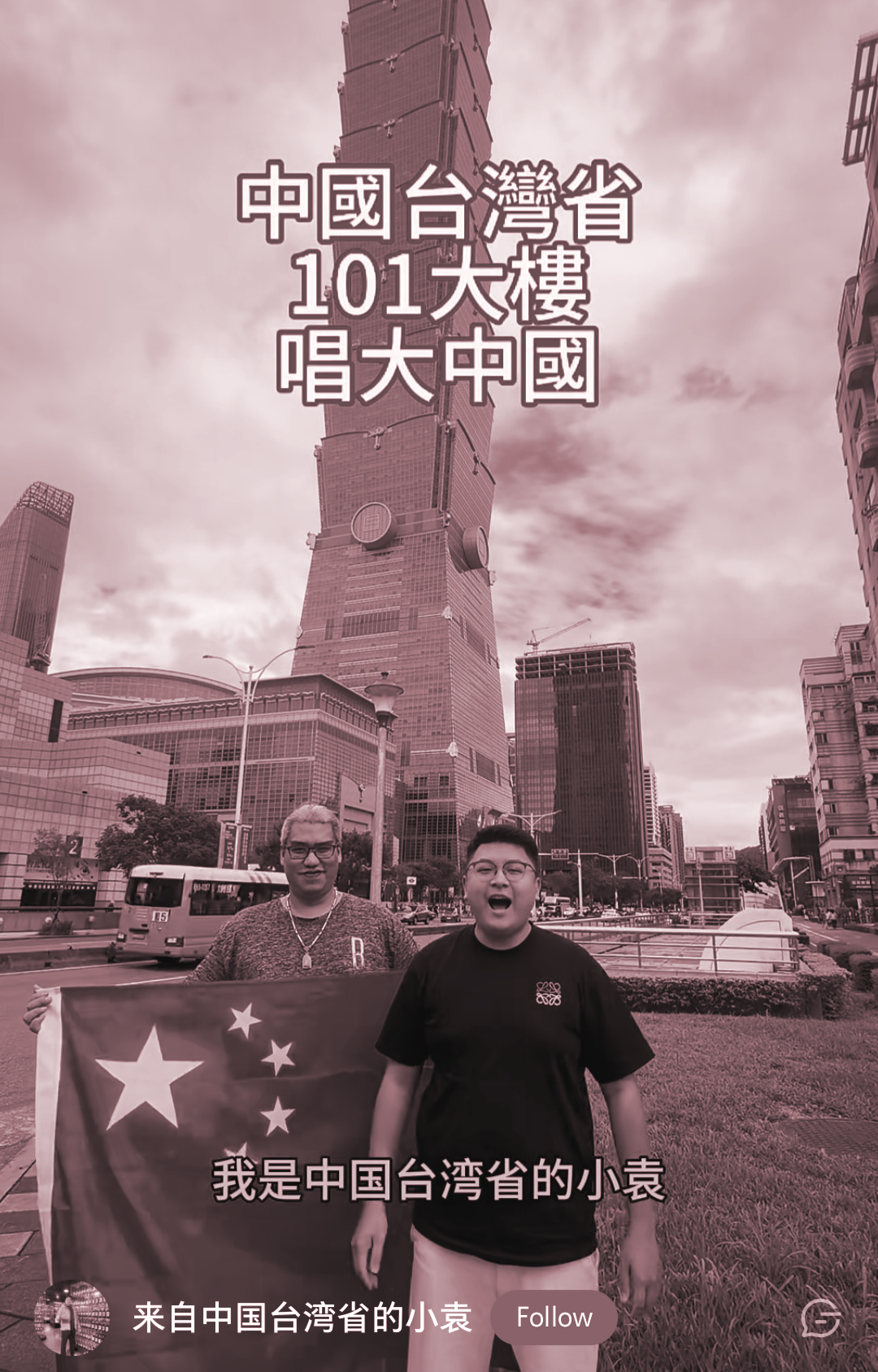
I equally see China hawks and pro-Taiwan pro-US camps misread this campaign as well. It’s not about making Taiwanese proudly say they’re Chinese, the way Cheng Li-wun stated [17]. Identity polling shows exclusive Taiwanese identification sitting near historic highs at roughly two-thirds and support for unification in the single digits, trends that have only strengthened through the entire Douyin era [18,19]. The actual goal is demobilisation, meaning a society that identifies as Taiwanese but won’t pay costs for it. Identity at record highs alongside willingness-to-fight sagging in the same polls is exactly the divergence that campaign is engineered to produce.
This is why I think the genre matters beyond the merits of its arguments. Whatever any individual author intends, its function is to move “the fight is unwinnable, the deal is inevitable” from unsayable to sayable to conventional. These authors will argue they’re just analysing the pressure behind the dam, while themselves being the pressure behind the dam.
The lake has no agency
The barrier-lake image is powerful because a lake has no agency. It only accumulates, and the villagers can only flee or drown. But every variable in the Taiwan equation is a choice rather than weather. Whether the PLA’s estimate of invasion cost rises or falls is a budgetary choice. Whether a quarantine meets stockpiles or empty tanks is a procurement choice. Whether Beijing’s intelligence picture reads “they’ll fold” or “they’ll fight” is the sum of a million small signals, including which essays a society writes about itself.
The frame I’d propose instead is option value against an absorbing state. The status quo is a position you can exit in any direction as the world changes: towards accommodation if China liberalises, towards deeper alignment if it doesn’t, towards hedging if America wobbles. Unification is a state you cannot exit at any price. Destroying option value in order to lock in terms your counterparty can unilaterally rewrite isn’t realism, and the trade already has a name. It’s the Budapest Memorandum, and it was Ukraine’s defining strategic error. The essays that invoke “avoiding Ukraine’s fate” as their reason to negotiate are prescribing the exact transaction that produced Ukraine’s fate, which is surrendering deterrent capability in exchange for paper guarantees from a revisionist neighbour [20].
When Taiwanese history is invoked for fatalism, you should actually hold this orthogonal (not opposite) reading. Sovereignty over this island has never once been settled by anything that happened on it. The Dutch fell to Koxinga’s fleet, the Zhengs to Qing conquest, the Qing held it for 212 years and lost it at Shimonoseki by losing a great-power war, and Japan lost it by losing a bigger one. Taiwan’s fate has always been decided by the metropole’s systemic crisis, which means that the strategy that has always worked, and the only one that ever has, is to still be standing, unassimilated and indigestible, when that crisis arrives. The Baltic states ran exactly this play against a superpower for fifty years: annexation never recognised, identity never surrendered, and statehood restored within months of the imperial crisis [21].
There is no victory condition here, only indefinite non-defeat, sustained until the structural variables move. It’s slow, unheroic and historically, the best-attested strategy this island has.
The defeatists are right that the lake is real. Where I think they’re wrong is about what kind of object it is. Dams are engineering problems, and engineering problems respond to work.
Loading replies…